GTU Scientists Conduct Research to Study Climate Change and Dangerous Meteorological Events
04-09-2025
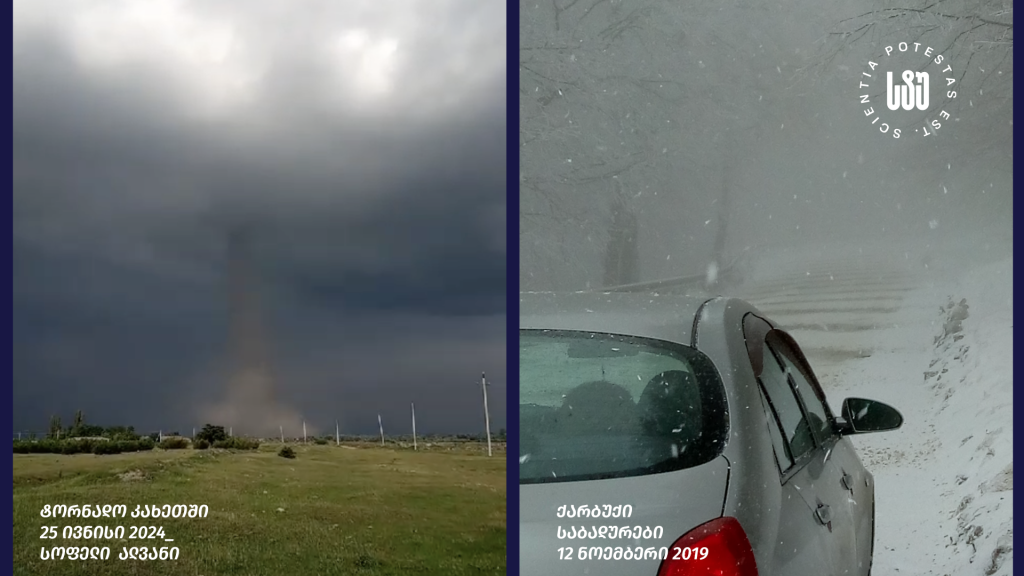
“Against the backdrop of global climate change, the intensity and duration of dangerous meteorological events in Georgia have sharply increased. This is evidenced by the increased incidence of gale-force winds and storms, which had not been observed before. For instance, on September 25th, 2021, a tornado (storm) developed at one of the terminals in the city of Poti, resulting in damage to infrastructure. On June 4th, 2023, a tornado was observed in the Samtskhe-Javakheti region, where in the village of Vachiani, strong hail was accompanied by wind that turned into a tornado, tearing off the roofs of many houses. Most recently, on June 25th, 2024, a tornado uprooted trees in Kakheti and damaged both the internal and external dome infrastructure at Alaverdi Monastery. On June 9th, 2024, heavy hail, rain, and wind affected the population in four municipalities of Imereti, causing problems in Sachkhere, Zestaponi, Baghdati, and Terjola municipalities, as well as damage to arable land and residential buildings. It is expected that hydrometeorological hazards such as severe floods, storms, landslides, avalanches, hail, droughts, and others will become more frequent and severe due to climate change, ecosystem degradation, population growth, and urbanization”, said Mikheil Pipia, Director of the Institute of Hydrometeorology of the Georgian Technical University and Chief Scientist of the Department of Climatology and Agrometeorology, while evaluating the grant project “Research on the climatic characteristics of hazardous meteorological events in the territory of Georgia”.
The leading organization of the grant project is the Georgian Technical University, and the co-leading organization is Ivane Javakhishvili Tbilisi State University. Accordingly, the project is being implemented at the Institute of Hydrometeorology of Georgian Technical University and the Mikheil Nodia Institute of Geophysics of Ivane Javakhishvili Tbilisi State University. An appropriate research environment has been created at these institutions to fulfill the set tasks.
The project involves Nazibrola Beglarashvili, Senior Research employee of the Department of Monitoring and Forecasting of Environmental Pollution of the GTU Institute of Hydrometeorology (project leader) and Mikheil Pipia (project coordinator), and from the co-leading organization, Nino Jamrishvili, Senior Research employee of the Atmospheric Physics Sector of the Mikheil Nodia Institute of Geophysics of the TSU (main project executor). The above-mentioned scientists are conducting research within the framework of the grant project “Research on the climatic characteristics of hazardous meteorological events in the territory of Georgia”.
As Nazibrola Beglarishvili states, the research goals to study the climatic characteristics (intensity, number of days, areas, recurrence, duration) of dangerous meteorological events (heavy precipitation, drought, frost, strong wind, hail, fog) in Georgia.
“A database of meteorological events for the last 50 years, 1973-2022, will be created for Georgia, and geoinformation maps of climatic characteristics - intensity, number of days, and recurrence will be developed. The main areas, duration will be determined, and the geographical regularities of these characteristics will be revealed. The most important task for the project is to form a database of dangerous meteorological events (heavy precipitation, drought, frost, strong wind, hail, fog). Data processing is underway; these data are: archival materials of the Institute of Hydrometeorology and the Mikheil Nodia Institute of Geophysics, climatic reports received from municipalities on damage caused by natural disasters, information disseminated through mass media, and the Internet. Each dangerous meteorological event is characterized by its own characteristics, It is precisely taking into account these features that a comprehensive assessment of the intensity of these events will be made. Based on the work performed, geoinformation maps of the intensity of natural meteorological events, as well as their average and maximum number of days, will be created. Also, the climatic characteristics of the studied hazardous meteorological events will be assessed. At the final stage, a summary of the work performed in previous periods will be made. A spatial-temporal analysis of the developed geoinformation maps and the climatic characteristics of the studied hazardous meteorological events will be carried out, their multi-year change will be assessed, and new geographical regularities will be identified. An innovative approach to the implementation of the project will be determined by the complex use of methods in the study of hazardous meteorological events”, states Nazibrola Beglarishvili.
One of the main goals of the research is to raise public awareness about hazardous meteorological events. Upon completion of the project, supporting/educational literature will be created, which can be considered intellectual property and will be used by the research team members in relevant lecture courses for students at universities.
The leading organization of the grant project is the Georgian Technical University, and the co-leading organization is Ivane Javakhishvili Tbilisi State University. Accordingly, the project is being implemented at the Institute of Hydrometeorology of Georgian Technical University and the Mikheil Nodia Institute of Geophysics of Ivane Javakhishvili Tbilisi State University. An appropriate research environment has been created at these institutions to fulfill the set tasks.
The project involves Nazibrola Beglarashvili, Senior Research employee of the Department of Monitoring and Forecasting of Environmental Pollution of the GTU Institute of Hydrometeorology (project leader) and Mikheil Pipia (project coordinator), and from the co-leading organization, Nino Jamrishvili, Senior Research employee of the Atmospheric Physics Sector of the Mikheil Nodia Institute of Geophysics of the TSU (main project executor). The above-mentioned scientists are conducting research within the framework of the grant project “Research on the climatic characteristics of hazardous meteorological events in the territory of Georgia”.
As Nazibrola Beglarishvili states, the research goals to study the climatic characteristics (intensity, number of days, areas, recurrence, duration) of dangerous meteorological events (heavy precipitation, drought, frost, strong wind, hail, fog) in Georgia.
“A database of meteorological events for the last 50 years, 1973-2022, will be created for Georgia, and geoinformation maps of climatic characteristics - intensity, number of days, and recurrence will be developed. The main areas, duration will be determined, and the geographical regularities of these characteristics will be revealed. The most important task for the project is to form a database of dangerous meteorological events (heavy precipitation, drought, frost, strong wind, hail, fog). Data processing is underway; these data are: archival materials of the Institute of Hydrometeorology and the Mikheil Nodia Institute of Geophysics, climatic reports received from municipalities on damage caused by natural disasters, information disseminated through mass media, and the Internet. Each dangerous meteorological event is characterized by its own characteristics, It is precisely taking into account these features that a comprehensive assessment of the intensity of these events will be made. Based on the work performed, geoinformation maps of the intensity of natural meteorological events, as well as their average and maximum number of days, will be created. Also, the climatic characteristics of the studied hazardous meteorological events will be assessed. At the final stage, a summary of the work performed in previous periods will be made. A spatial-temporal analysis of the developed geoinformation maps and the climatic characteristics of the studied hazardous meteorological events will be carried out, their multi-year change will be assessed, and new geographical regularities will be identified. An innovative approach to the implementation of the project will be determined by the complex use of methods in the study of hazardous meteorological events”, states Nazibrola Beglarishvili.
One of the main goals of the research is to raise public awareness about hazardous meteorological events. Upon completion of the project, supporting/educational literature will be created, which can be considered intellectual property and will be used by the research team members in relevant lecture courses for students at universities.