"Georgian Technical University Is a Strong Platform for Developing Successful Engineers and Leaders," – Announces a GTU Graduate
04-03-2025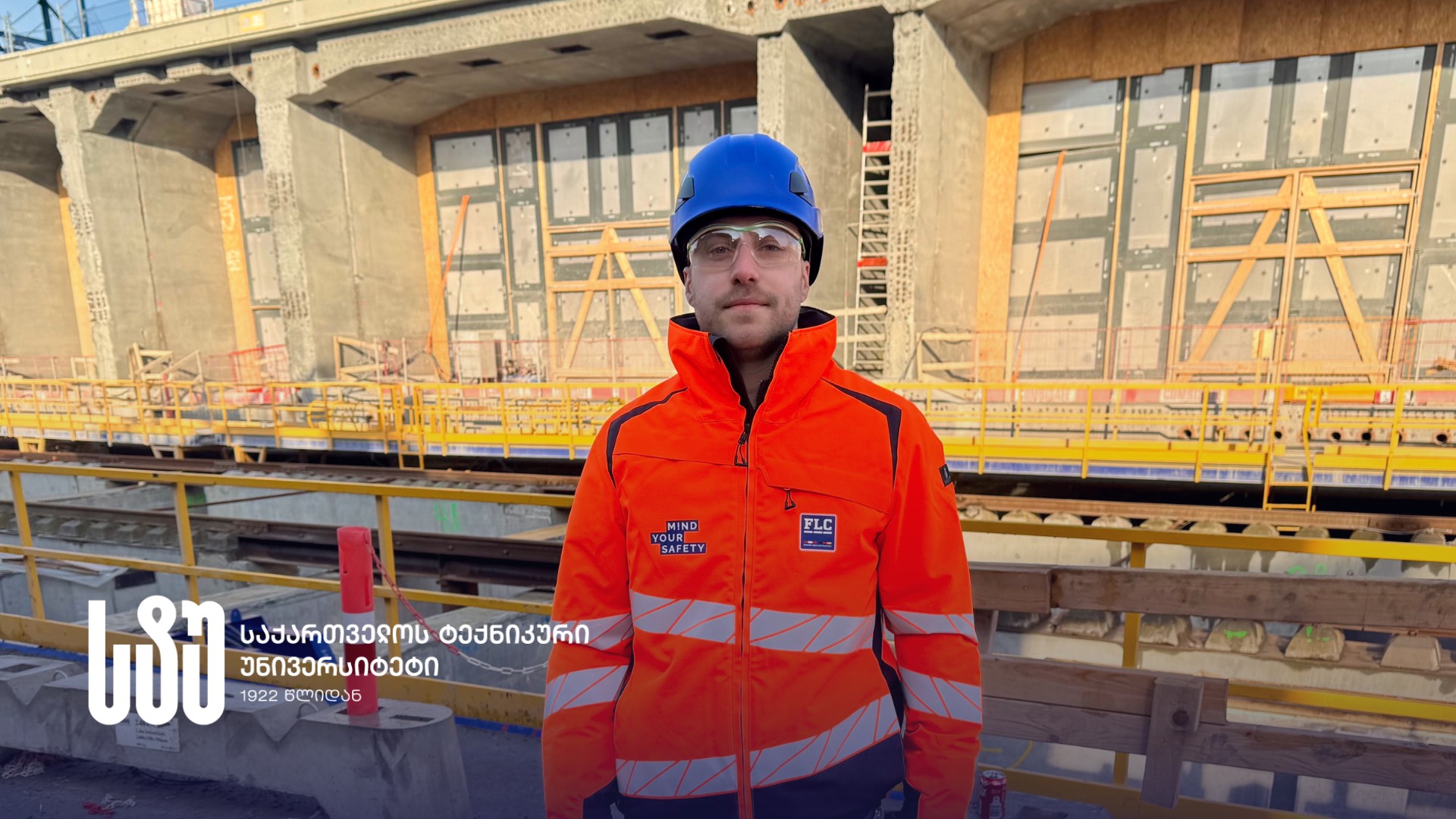
“I am Levan Bulia, 28 years old. I want to express my gratitude and respect to the Faculty of Construction of the Georgian Technical University, which gave me a solid foundation and an opportunity to develop my career on international projects. I hope that my story will be an inspiration for students of the Faculty of Construction and give them additional incentive not to be afraid of challenges and to set ambitious goals. Georgian Technical University is a strong platform for developing successful engineers and leaders, and I am proud to be its graduate,” says Levan Bulia, a graduate of the Georgian Technical University, who is participating in one of the world’s largest and most unique engineering projects, the Fehmarn Belt Tunnel, which will connect Denmark and Germany with an 18-kilometer underwater tunnel.
Levan Bulia, a 2019 graduate of the Faculty of Construction of the Georgian Technical University, has been working as a works supervisor in the sovereign state of Denmark, FLC (Femern Link Contractors), since 2025.
According to Levan Bulia, the theoretical knowledge gained at the Georgian Technical University played an important role in his career, which he uses in his daily work during the construction of such a large-scale project as the Fehmarn Belt Tunnel.
The Fehmarn Belt Tunnel will not only change Europe’s transport infrastructure but also create new economic and logistical opportunities, reduce travel times, and improve connectivity between the two countries.
“The construction of the Fehmarn Belt Tunnel involves innovative engineering solutions, including prefabricated concrete segments that are then placed on the seabed. The tunnel consists of 79 sections, each 217 meters long and weighing 73,000 tons. It includes both rail and road tunnels, providing one of the fastest and most environmentally friendly transport routes in Europe. My role in this project includes post-tensioning works, grouting, installation of external outfitting elements, and supervision of the workforce. My responsibility is to ensure that the work is carried out to a high standard, in compliance with safety standards, and according to the project schedule. This is a huge responsibility, as the durability and reliability of the tunnel in each section depend on these processes.
All this was possible thanks to the knowledge and skills I acquired at the university. I would especially like to mention and thank my lecturers – Mr. Irakli Kvaraia, Shakhi Bakanidze, Amiran Sakvarelidze, and Mrs. Nino Mskhiladze. Their professionalism, ability to transfer knowledge, and motivation were crucial to my success. Their lectures not only provided me with technical knowledge but also taught me engineering thinking, problem analysis, and management – skills that are now part of my daily work,” says Levan Bulia.
For information, the world’s longest and largest underwater tunnel is currently under construction in the northeastern of Germany. The tunnel will connect continental Europe to the Danish Island of Lolland. Its length will be 18 kilometers, and construction will be completed in 2029. The total cost of the project is 7 billion euros.
Levan Bulia, a 2019 graduate of the Faculty of Construction of the Georgian Technical University, has been working as a works supervisor in the sovereign state of Denmark, FLC (Femern Link Contractors), since 2025.
According to Levan Bulia, the theoretical knowledge gained at the Georgian Technical University played an important role in his career, which he uses in his daily work during the construction of such a large-scale project as the Fehmarn Belt Tunnel.
The Fehmarn Belt Tunnel will not only change Europe’s transport infrastructure but also create new economic and logistical opportunities, reduce travel times, and improve connectivity between the two countries.
“The construction of the Fehmarn Belt Tunnel involves innovative engineering solutions, including prefabricated concrete segments that are then placed on the seabed. The tunnel consists of 79 sections, each 217 meters long and weighing 73,000 tons. It includes both rail and road tunnels, providing one of the fastest and most environmentally friendly transport routes in Europe. My role in this project includes post-tensioning works, grouting, installation of external outfitting elements, and supervision of the workforce. My responsibility is to ensure that the work is carried out to a high standard, in compliance with safety standards, and according to the project schedule. This is a huge responsibility, as the durability and reliability of the tunnel in each section depend on these processes.
All this was possible thanks to the knowledge and skills I acquired at the university. I would especially like to mention and thank my lecturers – Mr. Irakli Kvaraia, Shakhi Bakanidze, Amiran Sakvarelidze, and Mrs. Nino Mskhiladze. Their professionalism, ability to transfer knowledge, and motivation were crucial to my success. Their lectures not only provided me with technical knowledge but also taught me engineering thinking, problem analysis, and management – skills that are now part of my daily work,” says Levan Bulia.
For information, the world’s longest and largest underwater tunnel is currently under construction in the northeastern of Germany. The tunnel will connect continental Europe to the Danish Island of Lolland. Its length will be 18 kilometers, and construction will be completed in 2029. The total cost of the project is 7 billion euros.