A Group of Scientists from the Georgian Technical University Working on New Achievements of a Global Experiment in Japan in Collaboration with Researchers Searching for Rare Electrons
28-01-2026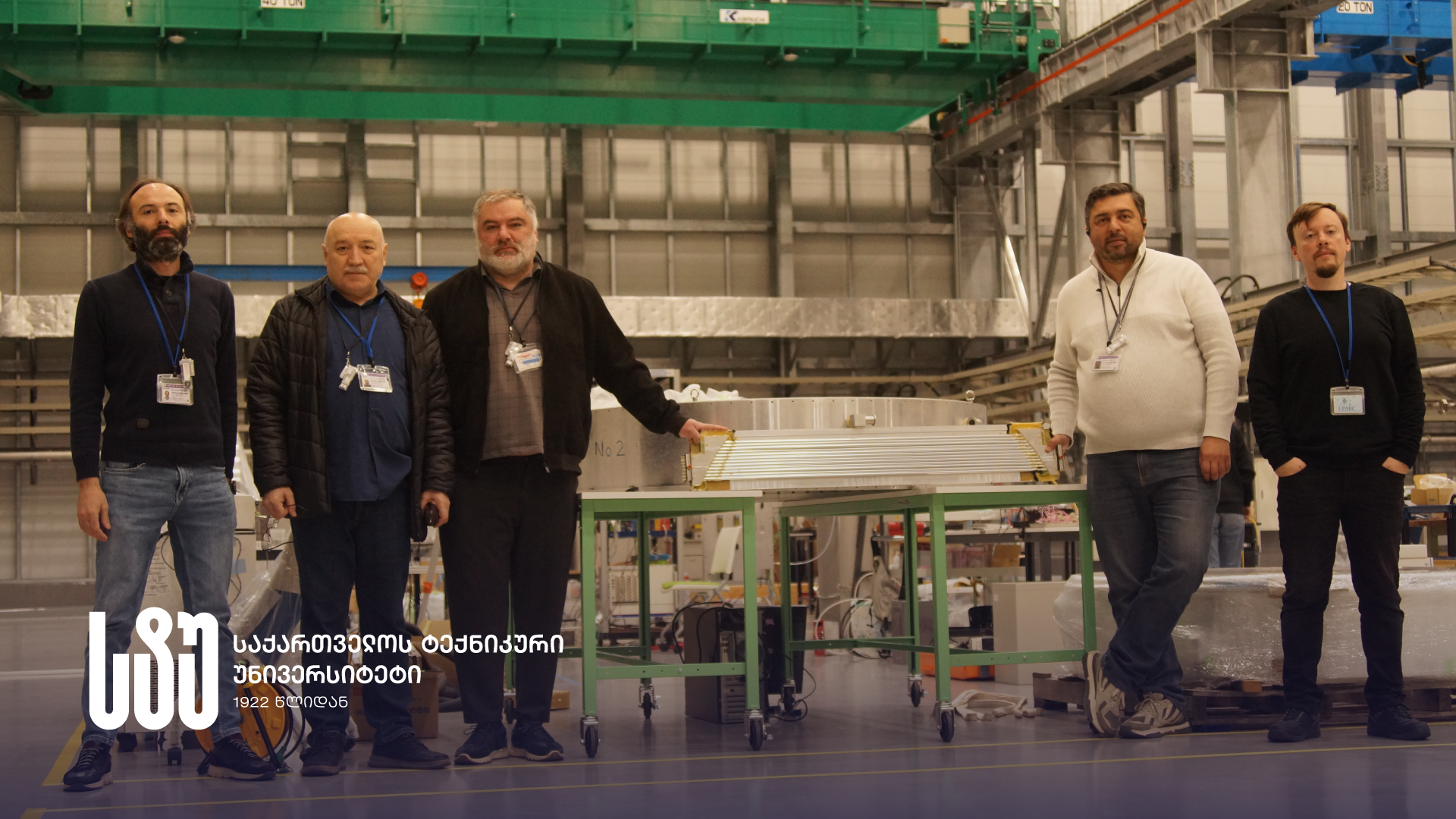
A group of scientists and engineers from the Georgian Technical University is continuing to work on new achievements of the global COMET experiment, which is currently underway at the Japan Proton Accelerator Research Complex (J-PARC) in Tokai, on the Pacific coast, in collaboration with renowned researchers searching for rare electrons, and is creating unique track detectors for the scientific experiment.
It is noteworthy that in the high-tech environment of J-PARC, within the framework of the COMET experiment, rare and unique phenomena related to elementary particles are being sought and observed. A group of scientists and engineers from the Institute of Quantum Physics and Engineering Technologies of the Georgian Technical University is actively involved in this process, making a significant contribution to the construction of the detectors.
According to Academician David Gurgenidze, Rector of the Georgian Technical University, the main mission of the COMET experiment is to verify the laws of physics by observing the transformation of a muon into an electron. According to the Rector, to accurately record this extremely challenging scientific moment, scientists require a track detector of exceptional sensitivity.
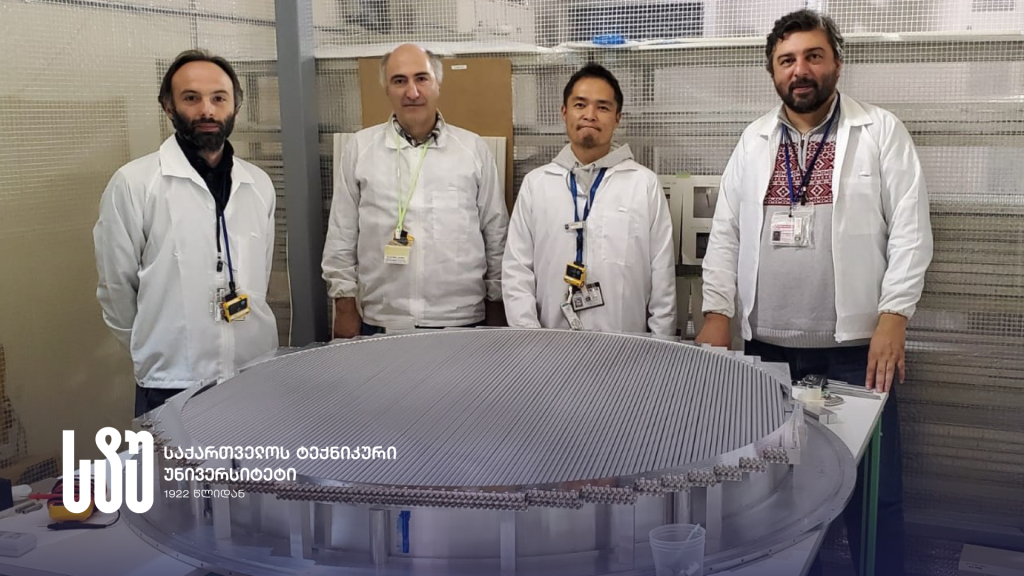
“This is where the highly qualified group of the Institute of Quantum Physics and Engineering Technologies of the Georgian Technical University comes in. Its members are the director of the institute, the representative of the Georgian government at CERN, the leader of our university’s scientific and engineering groups in the CERN CMS and Japanese COMET experiments, Professor Zviad Tsamalaidze, and research associates: Nikoloz Tsverava, Davit Chokheli, Roman Abramishvili, Tengiz Toriashvili, and Giorgi Adamov. Our scientists, specializing in high-energy physics instrumentation, in collaboration with the Japanese, successfully completed one of the most technically difficult tasks - the creation, assembly, and testing of the Straw Tracker detector system. “Straws” are ultralight, gas-filled tubes, the walls of which are thinner than a human hair. When a charged particle passes through them, a weak electrical signal is generated. By connecting thousands of straws together, an overlapping workspace is created that can track the trajectory of particles with microscopic precision.
It is noteworthy that a high-tech laboratory of straw track tubes has already been created at the Georgian Technical University, where 10 mm straw tubes were manufactured for the COMET experiment. This is undoubtedly a great success of the Georgian Technical University and its scientists. With the creation of the “track detector”, the awareness and rating of the Georgian Technical University and its scientific circles have significantly increased in the international space. It is remarkable that our students are also participating in this process along with scientists, and the tubes produced in the straw laboratory of the Georgian Technical University have already been sent to Japan - to KEK and J-PARC,” notes the rector, academician David Gurgenidze.
According to the assessment of the famous physicist, Professor Hajime Nishiguchi of the Institute of Particle and Nuclear Studies (IPNS) of the Japanese High Energy Accelerator Research Organization (KEK), the participation of scientists from the Georgian Technical University in the COMET experiment is critically important.
“The challenge of the COMET experiment is unique: it searches for extremely low-energy electrons. Standard detectors are either too thick or too lossy, scattering or absorbing the very particles that scientists are trying to study. This is where the expertise of the team of scientists from the Georgian Technical University is critically important. They are creating a system that is incredibly light and mechanically robust enough to withstand high-intensity currents, magnetic fields of up to 5 Tesla, and smooth operation in a vacuum.
For the Georgian scientists working at TOKAI, the daily reality is the processional process of precise measurements and equipment preparation. Their work is much more important than the mechanical execution of tasks,” says Professor Hajime Nishiguchi.
As part of the COMET experiment at J-PARC, a team of scientists and engineers from the Georgian Technical University is responsible for the entire life cycle of the detector modules and their future operation. As Professor Zviad Tsamalaidze, Director of the Institute of Quantum Physics and Engineering Technologies at GTU, notes, among the tasks to be performed are: precision measurement, which involves checking the tension and alignment of thousands of individual straw tubes with micron accuracy; electronics integration, which involves assembling and installing sensitive readout electronics to convert gas interactions into digital data; and system testing, which requires conducting rigorous “working conditions” tests on the modules before they are placed in the intense radiation environment of the experiment.
“This is a job that requires a rare combination of a physicist’s intuition and an engineer’s practicality. Within the framework of the COMET collaboration, the Georgian Technical University group is recognized as a team of highly professional people in the direction of creating and developing new equipment. If the COMET experiment is successful, it will provide us with the first evidence of “lepton flavor violation” - a discovery that reveals physics beyond the Standard Model of physics. To find this evidence, the detector must distinguish a specific “signal” electron from a background of millions of other particles. The extremely sensitive detector system, which is being developed by the Georgian Technical University group of scientists, is specially designed to capture the unprecedented (10-17) sensitivity of low-energy electrons,” notes the GTU scientist.
It is noteworthy that in the high-tech environment of J-PARC, within the framework of the COMET experiment, rare and unique phenomena related to elementary particles are being sought and observed. A group of scientists and engineers from the Institute of Quantum Physics and Engineering Technologies of the Georgian Technical University is actively involved in this process, making a significant contribution to the construction of the detectors.
According to Academician David Gurgenidze, Rector of the Georgian Technical University, the main mission of the COMET experiment is to verify the laws of physics by observing the transformation of a muon into an electron. According to the Rector, to accurately record this extremely challenging scientific moment, scientists require a track detector of exceptional sensitivity.
“This is where the highly qualified group of the Institute of Quantum Physics and Engineering Technologies of the Georgian Technical University comes in. Its members are the director of the institute, the representative of the Georgian government at CERN, the leader of our university’s scientific and engineering groups in the CERN CMS and Japanese COMET experiments, Professor Zviad Tsamalaidze, and research associates: Nikoloz Tsverava, Davit Chokheli, Roman Abramishvili, Tengiz Toriashvili, and Giorgi Adamov. Our scientists, specializing in high-energy physics instrumentation, in collaboration with the Japanese, successfully completed one of the most technically difficult tasks - the creation, assembly, and testing of the Straw Tracker detector system. “Straws” are ultralight, gas-filled tubes, the walls of which are thinner than a human hair. When a charged particle passes through them, a weak electrical signal is generated. By connecting thousands of straws together, an overlapping workspace is created that can track the trajectory of particles with microscopic precision.
It is noteworthy that a high-tech laboratory of straw track tubes has already been created at the Georgian Technical University, where 10 mm straw tubes were manufactured for the COMET experiment. This is undoubtedly a great success of the Georgian Technical University and its scientists. With the creation of the “track detector”, the awareness and rating of the Georgian Technical University and its scientific circles have significantly increased in the international space. It is remarkable that our students are also participating in this process along with scientists, and the tubes produced in the straw laboratory of the Georgian Technical University have already been sent to Japan - to KEK and J-PARC,” notes the rector, academician David Gurgenidze.
According to the assessment of the famous physicist, Professor Hajime Nishiguchi of the Institute of Particle and Nuclear Studies (IPNS) of the Japanese High Energy Accelerator Research Organization (KEK), the participation of scientists from the Georgian Technical University in the COMET experiment is critically important.
“The challenge of the COMET experiment is unique: it searches for extremely low-energy electrons. Standard detectors are either too thick or too lossy, scattering or absorbing the very particles that scientists are trying to study. This is where the expertise of the team of scientists from the Georgian Technical University is critically important. They are creating a system that is incredibly light and mechanically robust enough to withstand high-intensity currents, magnetic fields of up to 5 Tesla, and smooth operation in a vacuum.
For the Georgian scientists working at TOKAI, the daily reality is the processional process of precise measurements and equipment preparation. Their work is much more important than the mechanical execution of tasks,” says Professor Hajime Nishiguchi.
As part of the COMET experiment at J-PARC, a team of scientists and engineers from the Georgian Technical University is responsible for the entire life cycle of the detector modules and their future operation. As Professor Zviad Tsamalaidze, Director of the Institute of Quantum Physics and Engineering Technologies at GTU, notes, among the tasks to be performed are: precision measurement, which involves checking the tension and alignment of thousands of individual straw tubes with micron accuracy; electronics integration, which involves assembling and installing sensitive readout electronics to convert gas interactions into digital data; and system testing, which requires conducting rigorous “working conditions” tests on the modules before they are placed in the intense radiation environment of the experiment.
“This is a job that requires a rare combination of a physicist’s intuition and an engineer’s practicality. Within the framework of the COMET collaboration, the Georgian Technical University group is recognized as a team of highly professional people in the direction of creating and developing new equipment. If the COMET experiment is successful, it will provide us with the first evidence of “lepton flavor violation” - a discovery that reveals physics beyond the Standard Model of physics. To find this evidence, the detector must distinguish a specific “signal” electron from a background of millions of other particles. The extremely sensitive detector system, which is being developed by the Georgian Technical University group of scientists, is specially designed to capture the unprecedented (10-17) sensitivity of low-energy electrons,” notes the GTU scientist.