Rector of GTU, Academician David Gurgenidze, Delivered a Public Speech at the Georgian National Academy of Sciences
29-12-2025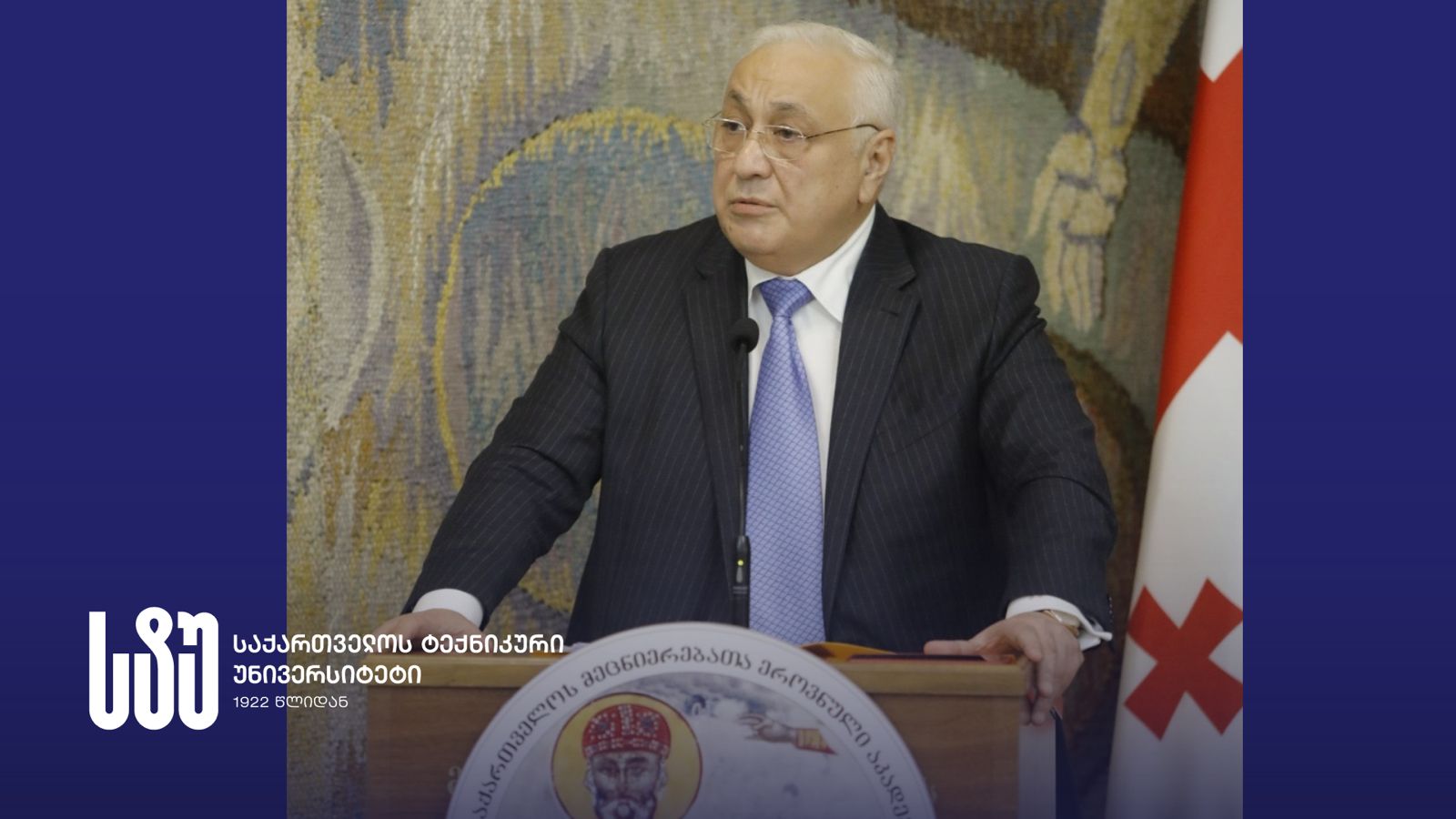
Rector of the Georgian Technical University, Member of the Presidium of the National Academy of Sciences, Academician David Gurgenidze delivered a public speech at the Georgian National Academy of Sciences, which was dedicated to the historical foundations of the establishment of a long-term, sustainable and strategic scientific collaboration between Georgia and the European Organization for Nuclear Research (CERN), the development of research relations over the decades, the current state and prospects.
The public hearing of the GTU Rector at the Georgian National Academy of Sciences was opened by the President of the Academy, Academician Roin Metreveli.
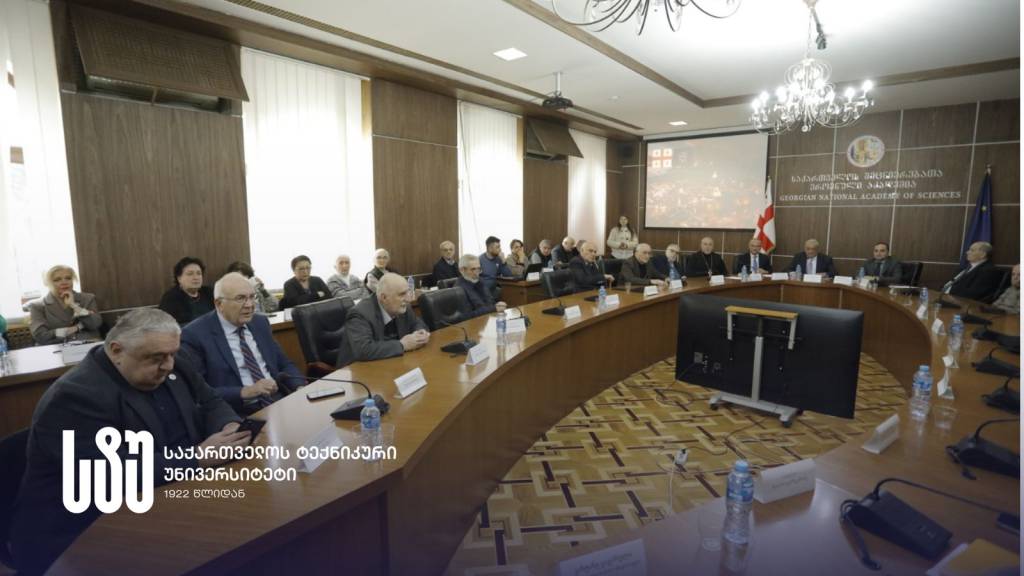
The report was heard by Deputy Minister of Education, Science and Youth of Georgia Zviad Gabisonia, Permanent Representative of Georgia to the UN Departments and other international organizations in Geneva Revaz Lominadze, Vice-President of the National Academy of Sciences Ramaz Khurodze, Academician-Secretary of the Academy Vladimer Papava, Academician-Secretary of the Department of Mathematics and Physics Giorgi Japaridze, Academician-Secretary of the Department of Engineering Sciences and Information Technologies Elguja Medzmariashvili, members of the Academy Presidium - General Advisor Giorgi Kvesitadze, Khvedri Inasaridze, Joni Khetsuriani, Jaba Samushia, Tamaz Shilakadze and academicians of the Academy of Sciences, as well as representatives of the administration of the Georgian Technical University and scientific and academic circles.
During his public speech, the Rector of the Georgian Technical University discussed the historical context of the establishment of one of the world’s largest scientific research centers in particle physics - the European Organization for Nuclear Research, its unique role in the development of fundamental research, technological innovations and science diplomacy on a global scale, and also spoke about the importance of CERN as an international research infrastructure for the progress of modern civilization.
Academician David Gurgenidze extensively reviewed the evolution of the involvement of Georgian scientific and research institutions in the CERN scientific ecosystem, including the Georgian Technical University and Ivane Javakhishvili Tbilisi State University, from the 1960s to the present day, focusing on their institutional participation in high-energy physics and engineering, and spoke about the contribution of Georgian scientists to such important experiments underway at CERN as CMS, ATLAS, and ShiP.
“On October 11th, 1996, at the initiative and efforts of the then President of the Georgian National Academy of Sciences - Academician Albert Tavkhelidze, and with the signatures of the then President of Georgia - Eduard Shevardnadze and the then Executive Director of CERN - Christoph Llewellyn, an international agreement in high-energy physics was concluded between the Government of Georgia and CERN. Since then, cooperation between Georgia and CERN can be considered a visible and impressive example of science diplomacy, where common values - freedom of knowledge, international cooperation and the use of science for peaceful purposes - harmoniously serve both the strengthening of national interests and the progress and intellectual advancement of the global scientific community. The active involvement of Georgia and its educational and research institutions in the multifaceted scientific ecosystem of CERN is based on the country’s strategic vision, which aims to integrate into the international in the research space, develop high-tech directions, and involve young scientists and engineers in world-class megaprojects. Such cooperation significantly strengthens Georgia’s academic and research capabilities, increases national scientific competitiveness and creates a solid institutional foundation for knowledge transfer, adaptation of innovative technologies and science-based socio-economic development. Today, the collaboration established between Georgia and CERN is a sustainable, dynamic and long-term cooperation that organically connects the national scientific potential with world-class research infrastructure. CERN, as a global leader in fundamental and applied sciences and one of the main generators of technological innovations, unites the intellectual resources of states, academic institutions, and leading scientists to understand and solve the most important fundamental questions facing humanity,” the rector noted.
According to Academician David Gurgenidze, in 2023, a new protocol was signed between Georgia-CERN with the involvement of GTU and TSU. According to which, Georgia is currently represented at CERN by a Georgian scientist, Director of the GTU Center for Quantum Physics and Engineering Technologies, Professor Zviad Tsamalaidze. In 2024, a new, significant memorandum of scientific partnership was signed between GTU and CERN within the framework of the “Future Circular Collider” research initiative, the implementation of which is planned for 2040-2045.
According to the rector, this event is also important in that a scientific agreement of this scale in the region has so far only been signed with the Georgian Technical University, which paves the way for Georgian scientific potential to participate in the largest megaprojects in the direction of fundamental research.
“Scientist groups from the Georgian Technical University and Tbilisi State University are actively involved in the CERN CMS and ATLAS experiments and are performing key tasks for the successful implementation of the world’s largest experiments. The members of the CMS experiment from our university are: Zviad Tsamalaidze, Arsen Khvedelidze, Yuri Baghaturia, David Chokheli, Aleksi Mestvirishvili, Irakli Lomidze, David Lomidze, Tengiz Toriashvili, Giorgi Adamov, Tamar Lominadze, Otar Kemularia, Sandro Melkadze, Ana Palavandishvili, and others, including myself; the members of the ATLAS experiment are: Besik Kekelia, Sasha Alikhanov, Nika Tsutskiridze, Ela Adamov, and others. It is worth noting that the Georgian Technical University has been a full member of the SHiP experiment since 2025, among 48 universities from 20 countries worldwide. We are actively participating in carrying out the Ship’s main tasks. This refers to the production of 20 mm diameter straw track tubes for the experiment. A straw production laboratory has already been created at the university, which successfully produced 10 mm straw tubes for the COMET experiment, which have already been sent to Japan, to KEK. Our scientists are successfully assembling, testing, and installing detectors for the first phase of the experiment. In addition, our scientific group is perfectly integrated into the Muon Detector, Hadron Calorimeter, and High Granularity Calorimeter collaborations, consistently expanding the research area and aiming to carry out fundamental and applied research focused on challenges,” said David Gurgenidze.
As the Rector of the Georgian Technical University stated at the end of his speech, to summarize, along with many years of continuous cooperation with CERN and tangible scientific and technological results, based on the effective support that Georgian scientific and academic institutions have from the Government of Georgia and Prime Minister Irakli Kobakhidze, the Ministry of Education, Science and Youth of Georgia and directly from Minister Givi Mikanadze, objective prerequisites have already been established for putting the issue of Georgia’s admission as an associate member of the European Organization for Nuclear Research (CERN) on the agenda.
According to David Gurgenidze, CERN associate membership is a unique opportunity of strategic importance for Georgia, which will allow the country to fully, systematically, and with institutional responsibility engage in both the latest research in fundamental physics and high-tech areas of applied physics and engineering sciences.
“Associate membership in CERN goes beyond academic cooperation and acquires the significance of a national development tool: it not only strengthens Georgia’s scientific and academic positions in the international arena, but also creates real and sustainable prerequisites for the transformation of acquired knowledge, research results, and technological innovations into national technological and industrial development. In the long term, this process will significantly contribute to the country’s economic growth, the formation of an innovative ecosystem, and the development of sectors with high added value, which is fully consistent with the strategic priorities of Georgia’s science and technological development,” noted David Gurgenidze at the end of his speech.
The public report of the Rector of the Georgian Technical University, Academician David Gurgenidze, and the key issues raised in it, as the best way to develop the country’s research potential and integrate it into the international scientific space, were highly appreciated by the President, Vice-President, and academicians of the Georgian National Academy of Sciences.
Opinions on raising the issue of Georgia’s associate membership in CERN were expressed by Zviad Gabisonia, Deputy Minister of Education, Science and Youth, and Revaz Lominadze, Permanent Representative of Georgia to the UN and other international organizations in Geneva.
As the author of the public report, Rector, Academician David Gurgenidze, stated at the meeting, it is desirable and necessary that the Georgian National Academy of Sciences be representatively and actively involved in the aforementioned processes.
The public hearing of the GTU Rector at the Georgian National Academy of Sciences was opened by the President of the Academy, Academician Roin Metreveli.
The report was heard by Deputy Minister of Education, Science and Youth of Georgia Zviad Gabisonia, Permanent Representative of Georgia to the UN Departments and other international organizations in Geneva Revaz Lominadze, Vice-President of the National Academy of Sciences Ramaz Khurodze, Academician-Secretary of the Academy Vladimer Papava, Academician-Secretary of the Department of Mathematics and Physics Giorgi Japaridze, Academician-Secretary of the Department of Engineering Sciences and Information Technologies Elguja Medzmariashvili, members of the Academy Presidium - General Advisor Giorgi Kvesitadze, Khvedri Inasaridze, Joni Khetsuriani, Jaba Samushia, Tamaz Shilakadze and academicians of the Academy of Sciences, as well as representatives of the administration of the Georgian Technical University and scientific and academic circles.
During his public speech, the Rector of the Georgian Technical University discussed the historical context of the establishment of one of the world’s largest scientific research centers in particle physics - the European Organization for Nuclear Research, its unique role in the development of fundamental research, technological innovations and science diplomacy on a global scale, and also spoke about the importance of CERN as an international research infrastructure for the progress of modern civilization.
Academician David Gurgenidze extensively reviewed the evolution of the involvement of Georgian scientific and research institutions in the CERN scientific ecosystem, including the Georgian Technical University and Ivane Javakhishvili Tbilisi State University, from the 1960s to the present day, focusing on their institutional participation in high-energy physics and engineering, and spoke about the contribution of Georgian scientists to such important experiments underway at CERN as CMS, ATLAS, and ShiP.
“On October 11th, 1996, at the initiative and efforts of the then President of the Georgian National Academy of Sciences - Academician Albert Tavkhelidze, and with the signatures of the then President of Georgia - Eduard Shevardnadze and the then Executive Director of CERN - Christoph Llewellyn, an international agreement in high-energy physics was concluded between the Government of Georgia and CERN. Since then, cooperation between Georgia and CERN can be considered a visible and impressive example of science diplomacy, where common values - freedom of knowledge, international cooperation and the use of science for peaceful purposes - harmoniously serve both the strengthening of national interests and the progress and intellectual advancement of the global scientific community. The active involvement of Georgia and its educational and research institutions in the multifaceted scientific ecosystem of CERN is based on the country’s strategic vision, which aims to integrate into the international in the research space, develop high-tech directions, and involve young scientists and engineers in world-class megaprojects. Such cooperation significantly strengthens Georgia’s academic and research capabilities, increases national scientific competitiveness and creates a solid institutional foundation for knowledge transfer, adaptation of innovative technologies and science-based socio-economic development. Today, the collaboration established between Georgia and CERN is a sustainable, dynamic and long-term cooperation that organically connects the national scientific potential with world-class research infrastructure. CERN, as a global leader in fundamental and applied sciences and one of the main generators of technological innovations, unites the intellectual resources of states, academic institutions, and leading scientists to understand and solve the most important fundamental questions facing humanity,” the rector noted.
According to Academician David Gurgenidze, in 2023, a new protocol was signed between Georgia-CERN with the involvement of GTU and TSU. According to which, Georgia is currently represented at CERN by a Georgian scientist, Director of the GTU Center for Quantum Physics and Engineering Technologies, Professor Zviad Tsamalaidze. In 2024, a new, significant memorandum of scientific partnership was signed between GTU and CERN within the framework of the “Future Circular Collider” research initiative, the implementation of which is planned for 2040-2045.
According to the rector, this event is also important in that a scientific agreement of this scale in the region has so far only been signed with the Georgian Technical University, which paves the way for Georgian scientific potential to participate in the largest megaprojects in the direction of fundamental research.
“Scientist groups from the Georgian Technical University and Tbilisi State University are actively involved in the CERN CMS and ATLAS experiments and are performing key tasks for the successful implementation of the world’s largest experiments. The members of the CMS experiment from our university are: Zviad Tsamalaidze, Arsen Khvedelidze, Yuri Baghaturia, David Chokheli, Aleksi Mestvirishvili, Irakli Lomidze, David Lomidze, Tengiz Toriashvili, Giorgi Adamov, Tamar Lominadze, Otar Kemularia, Sandro Melkadze, Ana Palavandishvili, and others, including myself; the members of the ATLAS experiment are: Besik Kekelia, Sasha Alikhanov, Nika Tsutskiridze, Ela Adamov, and others. It is worth noting that the Georgian Technical University has been a full member of the SHiP experiment since 2025, among 48 universities from 20 countries worldwide. We are actively participating in carrying out the Ship’s main tasks. This refers to the production of 20 mm diameter straw track tubes for the experiment. A straw production laboratory has already been created at the university, which successfully produced 10 mm straw tubes for the COMET experiment, which have already been sent to Japan, to KEK. Our scientists are successfully assembling, testing, and installing detectors for the first phase of the experiment. In addition, our scientific group is perfectly integrated into the Muon Detector, Hadron Calorimeter, and High Granularity Calorimeter collaborations, consistently expanding the research area and aiming to carry out fundamental and applied research focused on challenges,” said David Gurgenidze.
As the Rector of the Georgian Technical University stated at the end of his speech, to summarize, along with many years of continuous cooperation with CERN and tangible scientific and technological results, based on the effective support that Georgian scientific and academic institutions have from the Government of Georgia and Prime Minister Irakli Kobakhidze, the Ministry of Education, Science and Youth of Georgia and directly from Minister Givi Mikanadze, objective prerequisites have already been established for putting the issue of Georgia’s admission as an associate member of the European Organization for Nuclear Research (CERN) on the agenda.
According to David Gurgenidze, CERN associate membership is a unique opportunity of strategic importance for Georgia, which will allow the country to fully, systematically, and with institutional responsibility engage in both the latest research in fundamental physics and high-tech areas of applied physics and engineering sciences.
“Associate membership in CERN goes beyond academic cooperation and acquires the significance of a national development tool: it not only strengthens Georgia’s scientific and academic positions in the international arena, but also creates real and sustainable prerequisites for the transformation of acquired knowledge, research results, and technological innovations into national technological and industrial development. In the long term, this process will significantly contribute to the country’s economic growth, the formation of an innovative ecosystem, and the development of sectors with high added value, which is fully consistent with the strategic priorities of Georgia’s science and technological development,” noted David Gurgenidze at the end of his speech.
The public report of the Rector of the Georgian Technical University, Academician David Gurgenidze, and the key issues raised in it, as the best way to develop the country’s research potential and integrate it into the international scientific space, were highly appreciated by the President, Vice-President, and academicians of the Georgian National Academy of Sciences.
Opinions on raising the issue of Georgia’s associate membership in CERN were expressed by Zviad Gabisonia, Deputy Minister of Education, Science and Youth, and Revaz Lominadze, Permanent Representative of Georgia to the UN and other international organizations in Geneva.
As the author of the public report, Rector, Academician David Gurgenidze, stated at the meeting, it is desirable and necessary that the Georgian National Academy of Sciences be representatively and actively involved in the aforementioned processes.