"Prize for Breakthrough in Fundamental Physics" – Prestigious International Award Granted to GTU Scientists and Researchers
05-11-2025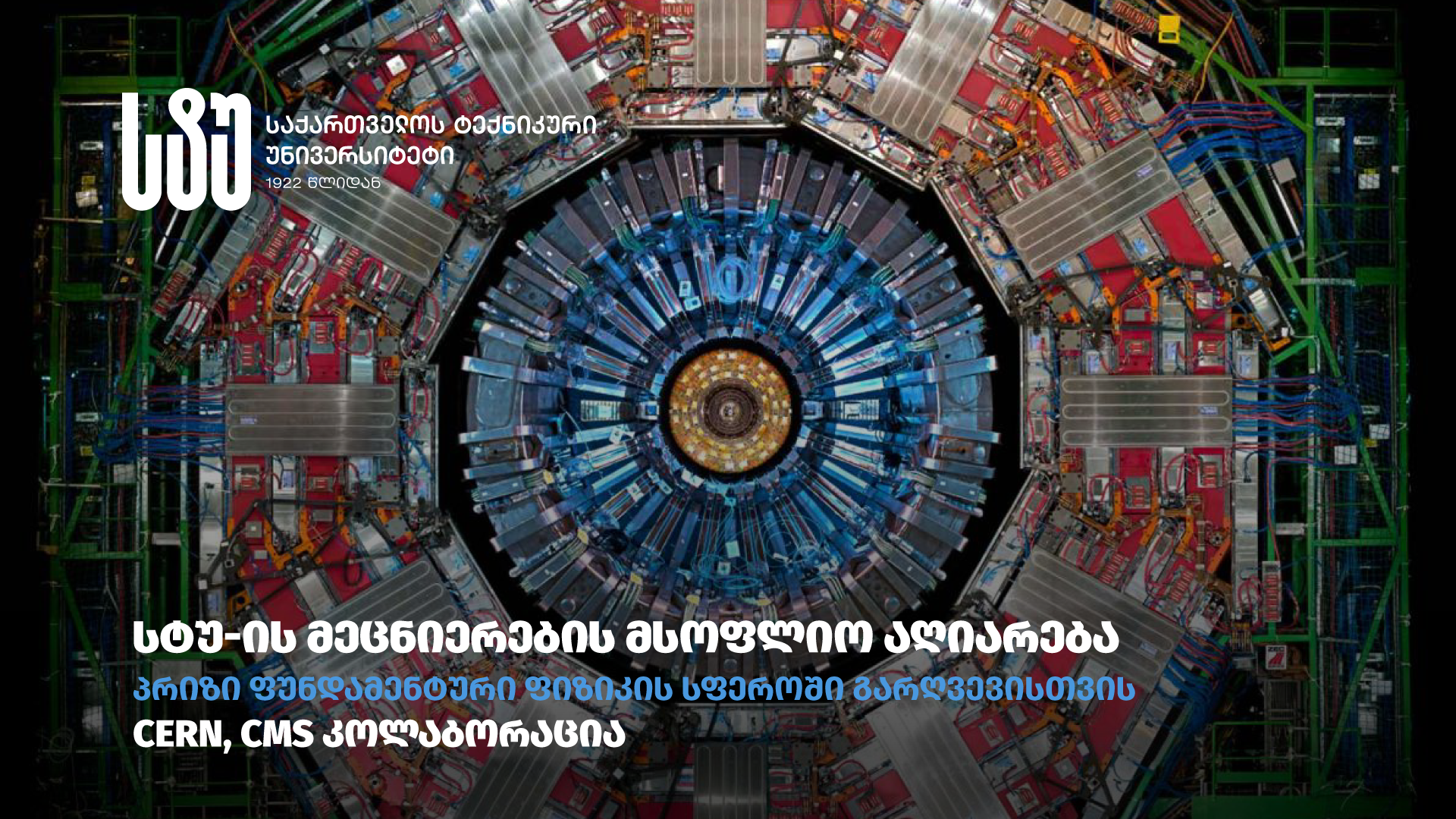
Scientists and engineers of the Institute of Quantum Physics and Engineering Technologies of the Georgian Technical University - members of the GTU CERN-LHC group - are among the 24 Georgian scientists who have received another major international recognition.
Georgian Technical University scientists and researchers were awarded one of the world’s most prestigious international scientific awards - the “Prize for Breakthrough in Fundamental Physics” for their significant success in the 2025 CMS collaboration at the European Organization for Nuclear Research (CERN).
The “Prize for Breakthrough in Fundamental Physics” was awarded to 8 scientists and engineers of the Georgian Technical University: Director of the Institute of Quantum Physics and Engineering Technologies, CERN-LHC Group Leader, and Georgian Government Representative at CERN Zviad Tsamalaidze, scientists and employees of the same institute, and members of the CERN-LHC Group - Arsen Khvedelidze, Yuri Baghaturia, Irakli Lomidze, David Lomidze, Giorgi Adamov, Alexi Mestvirishvili, and Tengiz Toriashvili. Rector of the Georgian Technical University, Associate Member of the CERN/CMS Collaboration, Academician David Gurgenidze, congratulates the Georgian scientists on receiving the prestigious international scientific award and notes that another international recognition once again confirms the solid contribution of Georgian science to the understanding of the nature of matter and the evolution of the universe.
The “Prize for Breakthrough in Fundamental Physics”, which was awarded to 24 Georgian scientists, including 8 scientists, researchers, and engineers from the Georgian Technical University, is an important international recognition not only for our university but also for Georgian science as a whole. Our scientists and engineers participate in all global research activities worldwide, including the largest scientific experiments at CERN, which largely determine the directions of fundamental and particle physics, making it possible to understand the universe even more deeply. The contribution of scientists from the Georgian Technical University to the CMS experiment at the Large Hadron Collider at CERN, where they use the latest technologies that will have a transformative impact on the future of humanity, should be particularly noted. I congratulate our scientists and engineers on receiving this prestigious international award and thank them for their selfless work and professionalism,” notes Rector David Gurgenidze.
Georgian Technical University is an active member of the CMS Collaboration of the Large Hadron Collider (LHC) program of the European Organization for Nuclear Research (CERN), and Georgian physicists are actively involved in its scientific activities.
The scientific activities of Georgian physicists in the CMS experiment are mainly carried out in the groups of 2 subdetectors, the muon system RPC (Resistive Plate Chamber) and the High Granularity Calorimeter HGCAL (High Granularity Calorimeter); their activity on the HGCAL calorimeter - the only detector that is a universal calorimetry and is being created for the first time in the world - should be especially noted. It is intended for the CMS experiment in connection with the transition of the collider to the High Luminosity Large Hadron Collider (HL-LHC) mode.
Georgian Technical University scientists and researchers were awarded one of the world’s most prestigious international scientific awards - the “Prize for Breakthrough in Fundamental Physics” for their significant success in the 2025 CMS collaboration at the European Organization for Nuclear Research (CERN).
The “Prize for Breakthrough in Fundamental Physics” was awarded to 8 scientists and engineers of the Georgian Technical University: Director of the Institute of Quantum Physics and Engineering Technologies, CERN-LHC Group Leader, and Georgian Government Representative at CERN Zviad Tsamalaidze, scientists and employees of the same institute, and members of the CERN-LHC Group - Arsen Khvedelidze, Yuri Baghaturia, Irakli Lomidze, David Lomidze, Giorgi Adamov, Alexi Mestvirishvili, and Tengiz Toriashvili. Rector of the Georgian Technical University, Associate Member of the CERN/CMS Collaboration, Academician David Gurgenidze, congratulates the Georgian scientists on receiving the prestigious international scientific award and notes that another international recognition once again confirms the solid contribution of Georgian science to the understanding of the nature of matter and the evolution of the universe.
The “Prize for Breakthrough in Fundamental Physics”, which was awarded to 24 Georgian scientists, including 8 scientists, researchers, and engineers from the Georgian Technical University, is an important international recognition not only for our university but also for Georgian science as a whole. Our scientists and engineers participate in all global research activities worldwide, including the largest scientific experiments at CERN, which largely determine the directions of fundamental and particle physics, making it possible to understand the universe even more deeply. The contribution of scientists from the Georgian Technical University to the CMS experiment at the Large Hadron Collider at CERN, where they use the latest technologies that will have a transformative impact on the future of humanity, should be particularly noted. I congratulate our scientists and engineers on receiving this prestigious international award and thank them for their selfless work and professionalism,” notes Rector David Gurgenidze.
Georgian Technical University is an active member of the CMS Collaboration of the Large Hadron Collider (LHC) program of the European Organization for Nuclear Research (CERN), and Georgian physicists are actively involved in its scientific activities.
The scientific activities of Georgian physicists in the CMS experiment are mainly carried out in the groups of 2 subdetectors, the muon system RPC (Resistive Plate Chamber) and the High Granularity Calorimeter HGCAL (High Granularity Calorimeter); their activity on the HGCAL calorimeter - the only detector that is a universal calorimetry and is being created for the first time in the world - should be especially noted. It is intended for the CMS experiment in connection with the transition of the collider to the High Luminosity Large Hadron Collider (HL-LHC) mode.