Public Lecture by One of the Leading Scientists at CERN, Leader of the Global CMS Collaboration, Professor Tiziano Camporesi, at GTU
29-10-2025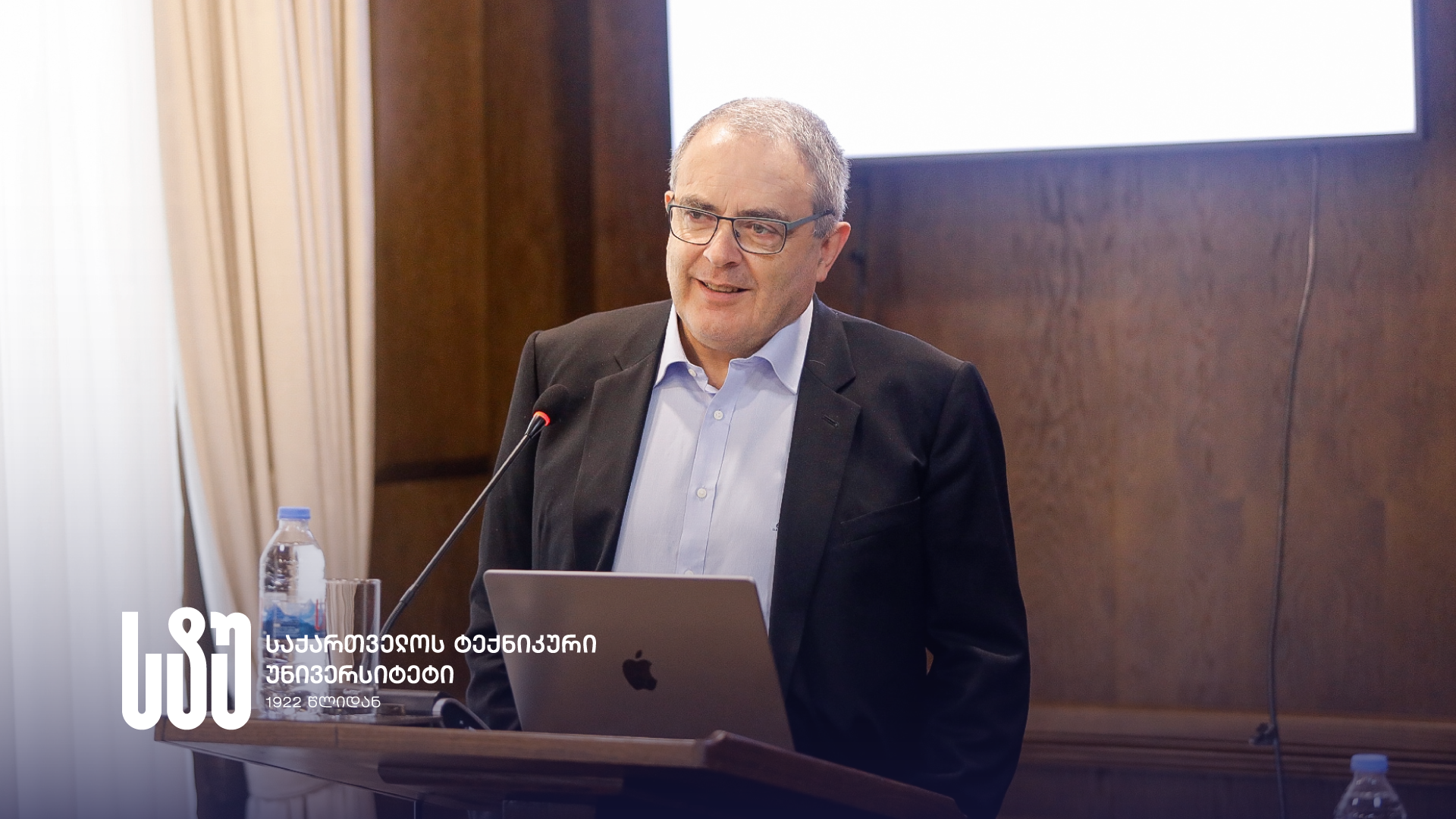
A famous physicist, scientist at the European Organization for Nuclear Research (CERN), one of the leaders of the CERN/CMS collaboration and experiment, Professor Tiziano Camporesi, who was on a working visit to the Georgian Technical University, held a public lecture for GTU students - Fundamental Research is Good for Your Health.
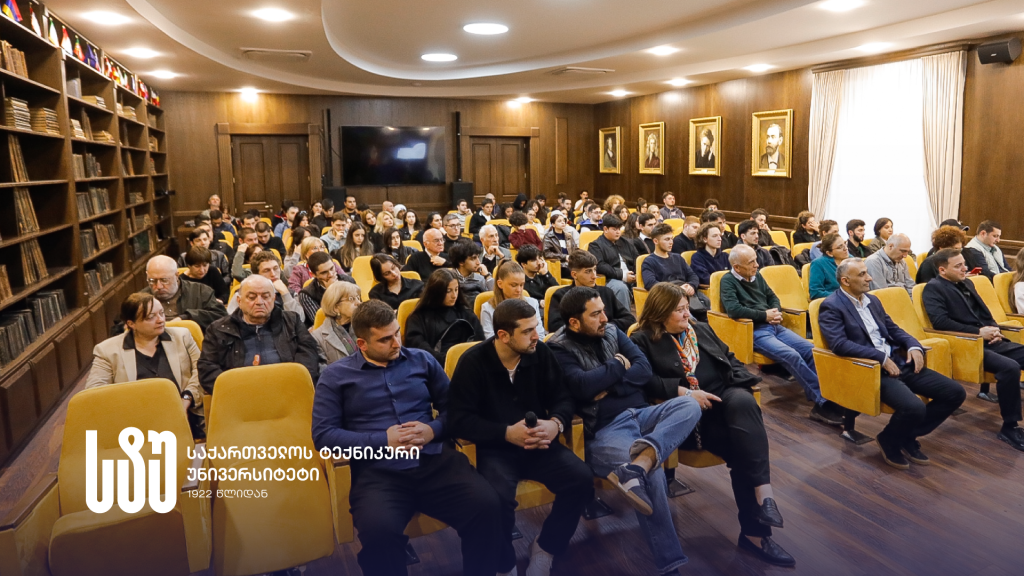
The public lecture was attended by the Vice-Rectors of the University Tamar Tsereteli and Tamar Lominadze, students of all three levels of the educational programs of Engineering and Medical Physics, Biomedical Engineering, Mathematics, Informatics and Computer Engineering of the Faculty of Informatics and Control Systems, researchers of the Department of Engineering Physics, scientists of the Institute of Quantum Physics and Engineering Technologies of GTU, as well as the Nuclear Engineering Center, engineers, and members of the GTU CERN-LHC group.
Professor Tamar Tsereteli opened the public lecture. She introduced one of the leading scientists of the CERN/CMS collaboration, Dr. Professor Tiziano Camporesi, to the gathered public.
According to the Vice-Rector, sharing Professor Camporesi’s many years of scientific experience, the example of global scientific experiments underway at CERN will undoubtedly be interesting for students of relevant programs at the Georgian Technical University. As Tamar Tsereteli said, Tiziano Camporesi, who is currently one of the leaders of the CERN/CMS collaboration and the former spokesperson of the CERN/CMS collaboration, has been involved in the most important research in the field of nuclear and particle physics for many years. In addition, he has been actively collaborating with the Georgian Technical University, the Rector, Academician David Gurgenidze, and members of the CERN-LHC group of the GTU for many years.
As Tamar Tsereteli noted, within the framework of the collaboration, the CERN scientist has delivered several public lectures to students and scientific circles, and in today’s public lecture, he will review how effectively innovations in particle physics and accelerator technology, in particular radiation-related research, are being used within the framework of ongoing global experiments for human health, improving disease diagnostics and treatment methods.
Professor Camporesi began the public lecture with the main message: fundamental science, including particle physics, is not just abstract knowledge, but is the basis for improving human health and the quality of life.
The scientist spoke about how fundamental research and scientific achievements in particle physics are related to human health and the development of medicine; he emphasized that scientific research creates advanced technologies that lay the foundation for new methods of medical diagnostics and treatment.
According to Tiziano Camporesi, radiation, which is one of the main tools of fundamental research, allows the destruction of tumor cells.
The CERN scientist discussed the processes of controlling radiation and producing isotopes through accelerators. According to him, accelerators, which accelerate charged particles, are widely used both in fundamental physics and for medical purposes, including: for the production of isotopes, medical diagnostics and therapy; he noted that radiography, angiography, isotope studies, computed tomography (CT) and positron emission tomography (PET) allow us to non-invasively see internal human organs and systems, while the combined PET/CT system provides a single acquisition of functional and anatomical data of the body.
The CERN scientist explained to the students that the destruction of a cell occurs when it loses its ability to reproduce - when radiation acts on the cell nucleus and damages DNA, and emphasized that proton therapy is one of the most promising directions today, because protons direct energy in a targeted manner and do not damage healthy tissues. According to him, scientists are already actively exploring the possibilities of treatment with heavy ions, for example, carbon ions, which in the future can become a much more effective direction in the fight against oncological diseases.
After the public lecture, a discussion was held, moderated by Professor Zviad Tsamalaidze, Director of the Institute of Quantum Physics and Engineering Technologies of the Georgian Technical University, leader of the CERN-LHC university group, and representative of the Georgian government at CERN.
GTU scientists, young researchers, and students participated in the discussion.
The public lecture was attended by the Vice-Rectors of the University Tamar Tsereteli and Tamar Lominadze, students of all three levels of the educational programs of Engineering and Medical Physics, Biomedical Engineering, Mathematics, Informatics and Computer Engineering of the Faculty of Informatics and Control Systems, researchers of the Department of Engineering Physics, scientists of the Institute of Quantum Physics and Engineering Technologies of GTU, as well as the Nuclear Engineering Center, engineers, and members of the GTU CERN-LHC group.
Professor Tamar Tsereteli opened the public lecture. She introduced one of the leading scientists of the CERN/CMS collaboration, Dr. Professor Tiziano Camporesi, to the gathered public.
According to the Vice-Rector, sharing Professor Camporesi’s many years of scientific experience, the example of global scientific experiments underway at CERN will undoubtedly be interesting for students of relevant programs at the Georgian Technical University. As Tamar Tsereteli said, Tiziano Camporesi, who is currently one of the leaders of the CERN/CMS collaboration and the former spokesperson of the CERN/CMS collaboration, has been involved in the most important research in the field of nuclear and particle physics for many years. In addition, he has been actively collaborating with the Georgian Technical University, the Rector, Academician David Gurgenidze, and members of the CERN-LHC group of the GTU for many years.
As Tamar Tsereteli noted, within the framework of the collaboration, the CERN scientist has delivered several public lectures to students and scientific circles, and in today’s public lecture, he will review how effectively innovations in particle physics and accelerator technology, in particular radiation-related research, are being used within the framework of ongoing global experiments for human health, improving disease diagnostics and treatment methods.
Professor Camporesi began the public lecture with the main message: fundamental science, including particle physics, is not just abstract knowledge, but is the basis for improving human health and the quality of life.
The scientist spoke about how fundamental research and scientific achievements in particle physics are related to human health and the development of medicine; he emphasized that scientific research creates advanced technologies that lay the foundation for new methods of medical diagnostics and treatment.
According to Tiziano Camporesi, radiation, which is one of the main tools of fundamental research, allows the destruction of tumor cells.
The CERN scientist discussed the processes of controlling radiation and producing isotopes through accelerators. According to him, accelerators, which accelerate charged particles, are widely used both in fundamental physics and for medical purposes, including: for the production of isotopes, medical diagnostics and therapy; he noted that radiography, angiography, isotope studies, computed tomography (CT) and positron emission tomography (PET) allow us to non-invasively see internal human organs and systems, while the combined PET/CT system provides a single acquisition of functional and anatomical data of the body.
The CERN scientist explained to the students that the destruction of a cell occurs when it loses its ability to reproduce - when radiation acts on the cell nucleus and damages DNA, and emphasized that proton therapy is one of the most promising directions today, because protons direct energy in a targeted manner and do not damage healthy tissues. According to him, scientists are already actively exploring the possibilities of treatment with heavy ions, for example, carbon ions, which in the future can become a much more effective direction in the fight against oncological diseases.
After the public lecture, a discussion was held, moderated by Professor Zviad Tsamalaidze, Director of the Institute of Quantum Physics and Engineering Technologies of the Georgian Technical University, leader of the CERN-LHC university group, and representative of the Georgian government at CERN.
GTU scientists, young researchers, and students participated in the discussion.