A Group of Scientists from GTU has Developed a New Type of Dye-Sensitized Solar Cell
18-08-2025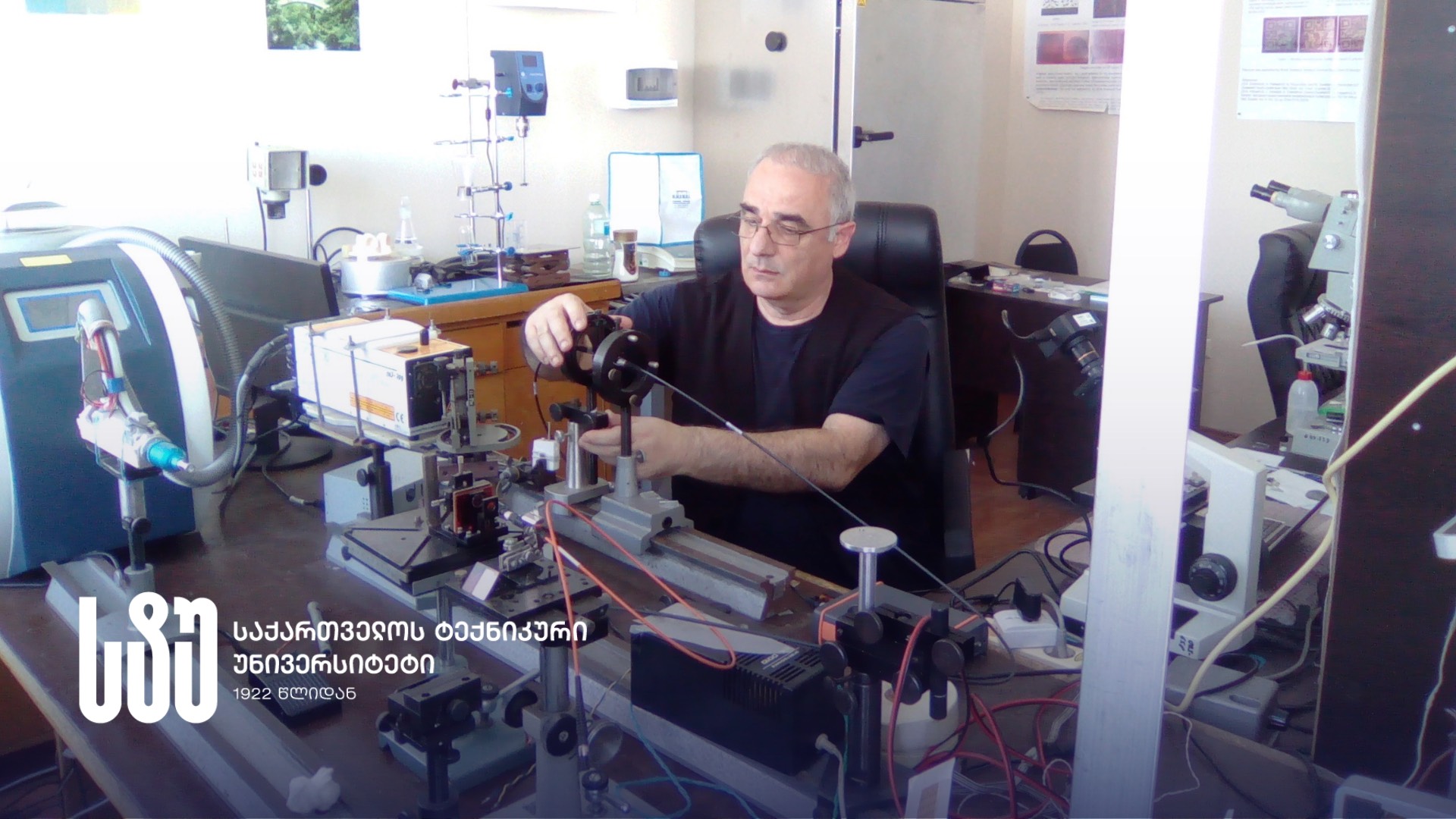
“Due to the low cost, durability, robustness, environmental safety, and ease of use of the solar cell we developed, the dye-sensitized photonic liquid crystal solar cell can be installed both in densely populated areas and in hard-to-reach locations. At this stage, we are conducting experiments to optimize the concentration ratios of the optical, thermal, electro-optical, and solar cell components. Working prototypes have already been created and their physical parameters are being optimized in order to maximize the conversion of light intensities emitted by solar or artificial light sources into electrical energy,” says Gia Petriashvili, Chief Scientist at the Vladimer Chavchanidze Institute of Cybernetics of the Georgian Technical University.
A group of scientists from the Vladimer Chavchanidze Institute of Cybernetics of the Georgian Technical University, led by Gia Petriashvili, has developed a new type of dye-sensitized photonic liquid crystal solar cell, the widespread use of which, as Gia Petriashvili states, will reduce the share of triadic sources of electricity generation, which, in turn, causes environmental pollution.
According to the GTU scientist, this will be a significant step forward toward a more sustainable and affordable solar energy future. Therefore, continued research and development in the field are vital to unlock the full potential of these promising technologies and accelerate the transition to clean energy.

“When we talk about the energy efficiency and performance of these systems, it should be emphasized that there are several methods of converting the intensity of solar radiation into electrical energy, and devices based on them. The most promising are solar cells, also known as photovoltaic cells, which are devices that directly convert sunlight into electrical energy. Of these, the most common are silicium-based solar cells. However, they have several disadvantages, including the thickness of the photosensitive layer, complex manufacturing technology, high cost, and temperature dependence in the conversion of light into electrical energy. In particular, with increasing temperature, the efficiency of converting light into electrical energy drops sharply. Currently, solar cells have been developed, or are in the development stage, which show a higher degree of conversion of light into electrical energy than traditional silicon elements.
All over the world, new types of solar cells are being actively developed that are based on simple manufacturing technology, have a high coefficient of light-to-electricity conversion, and are not subject to temperature limitations. In this regard, the most promising converter is a dye-sensitized solar cell; active research is underway to improve its parameters. It consists of plasmonic nanoparticles coated on the surface of electrically conductive glass, organic luminescent dyes, and certain types of electrolytes. As a result of experiments, it was found that the efficiency of the new type of dye-sensitized solar cell developed by us is higher than that of silicium-based solar cells. Optimization studies are currently underway to further increase the optical and thermo-optical parameters of the presented solar cell,” says Gia Petriashvili.
According to the GTU scientist, Georgia has great potential in the field of renewable energies, including wind and thermal energies. However, solar energy can play a decisive role in the transition to a clean, renewable, and energy-independent world.
Gia Petriashvili states that it has been determined that the intensity of the sun's irradiation on one square meter of the Earth is approximately 1,000 watts. This amount of radiation can generate 85,000 terawatts globally, while the total energy consumed in the world is currently 15 terawatts.
“As a rule, in existing solar cells and light-to-electricity converters, organic and inorganic liquids based on acid/alkali are used as electrolytes; however, they have many drawbacks, such as volatility, environmental pollution, high probability of leakage, and, as a result, the need for special insulation. Also, the temperature dependence of efficiency is a problem. For the first time, in the solar cell proposed by us, a liquid crystal substance is used as an electrolyte. Replacing the liquid crystal electrolyte significantly improves the parameters of a dye-sensitized photonic liquid crystal solar cell. In particular, the liquid crystal is environmentally safe, it is not volatile and does not require deep insulation, the efficiency of light conversion into electricity increases with increasing temperature, it has a long service life, the manufacturing technology is simple and inexpensive. As a result of multiple internal reflections of light by the photonic crystal, the solar cell’s efficiency is increasing significantly,” announces Gia Petriashvili.
A group of scientists from the Vladimer Chavchanidze Institute of Cybernetics of the Georgian Technical University, led by Gia Petriashvili, has developed a new type of dye-sensitized photonic liquid crystal solar cell, the widespread use of which, as Gia Petriashvili states, will reduce the share of triadic sources of electricity generation, which, in turn, causes environmental pollution.
According to the GTU scientist, this will be a significant step forward toward a more sustainable and affordable solar energy future. Therefore, continued research and development in the field are vital to unlock the full potential of these promising technologies and accelerate the transition to clean energy.
“When we talk about the energy efficiency and performance of these systems, it should be emphasized that there are several methods of converting the intensity of solar radiation into electrical energy, and devices based on them. The most promising are solar cells, also known as photovoltaic cells, which are devices that directly convert sunlight into electrical energy. Of these, the most common are silicium-based solar cells. However, they have several disadvantages, including the thickness of the photosensitive layer, complex manufacturing technology, high cost, and temperature dependence in the conversion of light into electrical energy. In particular, with increasing temperature, the efficiency of converting light into electrical energy drops sharply. Currently, solar cells have been developed, or are in the development stage, which show a higher degree of conversion of light into electrical energy than traditional silicon elements.
All over the world, new types of solar cells are being actively developed that are based on simple manufacturing technology, have a high coefficient of light-to-electricity conversion, and are not subject to temperature limitations. In this regard, the most promising converter is a dye-sensitized solar cell; active research is underway to improve its parameters. It consists of plasmonic nanoparticles coated on the surface of electrically conductive glass, organic luminescent dyes, and certain types of electrolytes. As a result of experiments, it was found that the efficiency of the new type of dye-sensitized solar cell developed by us is higher than that of silicium-based solar cells. Optimization studies are currently underway to further increase the optical and thermo-optical parameters of the presented solar cell,” says Gia Petriashvili.
According to the GTU scientist, Georgia has great potential in the field of renewable energies, including wind and thermal energies. However, solar energy can play a decisive role in the transition to a clean, renewable, and energy-independent world.
Gia Petriashvili states that it has been determined that the intensity of the sun's irradiation on one square meter of the Earth is approximately 1,000 watts. This amount of radiation can generate 85,000 terawatts globally, while the total energy consumed in the world is currently 15 terawatts.
“As a rule, in existing solar cells and light-to-electricity converters, organic and inorganic liquids based on acid/alkali are used as electrolytes; however, they have many drawbacks, such as volatility, environmental pollution, high probability of leakage, and, as a result, the need for special insulation. Also, the temperature dependence of efficiency is a problem. For the first time, in the solar cell proposed by us, a liquid crystal substance is used as an electrolyte. Replacing the liquid crystal electrolyte significantly improves the parameters of a dye-sensitized photonic liquid crystal solar cell. In particular, the liquid crystal is environmentally safe, it is not volatile and does not require deep insulation, the efficiency of light conversion into electricity increases with increasing temperature, it has a long service life, the manufacturing technology is simple and inexpensive. As a result of multiple internal reflections of light by the photonic crystal, the solar cell’s efficiency is increasing significantly,” announces Gia Petriashvili.